Went to Artomatic - the giant annual exhibit of local artists' work - the weekend before last. I've been meaning to go for several years now, but for one reason or another, haven't made it until now. This year, two friends were exhibiting, and although I've seen the work of both before, I went partially out of a desire to show support.
The exhibit was absolutely enormous - nine floors of a giant office building-to-be, filled wall to wall with displays. There was absolutely no way we could see everything in a single visit, so I focused on photography, partly because one of my exhibiting friends is a photographer, partly because I just love a good artistic photo, but mostly because even among no-name local photographers, the quality tends to be far higher than among their painting, drawing or, worse, installation-creating brethren.
Our group managed to cover three of the nine floors, and even there I could not mention every photographer worth mentioning. Some highlights were Jeffrey Boodman's Ansel Adams-esque balck and white landscapes, Chris Campbell's digitally tweaked mix of shiny, colorful exteriors and decaying interiors, and - perhaps my favorite - Barry Schmetter's series "Memory and Forgetting" - shot with vintage medium and large format cameras, it was dreamy and chilling at the same time. It put me in mind of W.G. Sebald's book The Emigrants.
Of the non-photographic material, though I wasn't paying attention, Amy Combs' charcoals definitely jumped out.
Next year - several visits, no question about it.
Showing posts with label art. Show all posts
Showing posts with label art. Show all posts
Monday, July 6, 2009


Monday, January 5, 2009
Philadelphia, Day One
The morning after our wedding in mid-November, J. and I took the train to Philadelphia for the weekend, for a micro-honeymoon of sorts. The trip was largely symbolic – we’re planning a real, albeit much-delayed, honeymoon, this coming spring – we mostly wanted to get away from the over-excited visiting families and get a change of scenery.
The train was a bit late to depart, but once on the way, the ride was trouble-free, and a hair over two hours later we pulled into 30th Street Station in the city of brotherly love. We took the streetcar – one of a seemingly endless variety of public conveyances in Philly, and a gross misnomer, for it spent not a moment of its trip above ground – downtown, checked our bags at the hotel and set out in search of lunch. Owing to the wedding, I did virtually no research on Philly before we left. We had been there once before, but it was several years ago, and we went with our friend C.S., who knew the city really well, so we were content just to follow him and his girlfriend around. This time, we were on our own, and in the absence of any information on lunch-appropriate spots in the vicinity of our hotel, ended up just grabbing a slice of pizza around the corner. It was surprisingly good – very much in the style of the New York’s famous slices, and though not quite that good, it was close. Our friend N. would later comment that she found Philadelphia to be an unfriendly city. I believe it stems from its frustration over its desire to be a New York in some important ways, but never quite reaching that ideal. The pizza was just a small manifestation of that.
Our lunch consumed, we set out for the Philadelphia Art Museum. According to the map we had picked up at the train station, the Museum occupied a location somewhat akin to the Kennedy Center in DC – not that far from anything, but not easy to get to. There was no Metro station anywhere near the museum, and Philly’s bus system looked intimidating even to a transit rat like me, so we walked. The weather was unseasonably warm – it would reach 71 degrees that afternoon – and the walk along Ben Franklin Parkway (more of a boulevard) pleasant.
The Museum is vast – the third largest in the US, after the Met and, I presume, either the National Gallery or maybe the Chicago Institute. There was no way we could see the entire thing in an afternoon, and we would not have wanted to, but we saw enough to make the visit memorable.
The current Classical style building was completed in 1928, though it looks older, and was the product of multiple architects and firms, which accounts for its generic architecture. It is enormous and is more functional than beautiful. Though superficially similar to the Met, it lacks the latter’s sense of proportion, especially when viewed from the front.
Some of the highlights and pleasant surprises we encountered were some early Miro from roughly 1920 that looked nothing like what we think of when his name is mentioned, some late, non-Cubist work by Georges Braque, and some seriously creepy modernist Mexican paintings by artists I was not familiar with. There was also a large gallery dedicated to the sculpture of Constantin Brancusi, which I enjoyed thoroughly, though J. was less enthused. Philly’s collection of Asian art, which we had to see selectively for lack of time, seemed heavy on Chinese artifacts, including, improbably, a complete study of a Chi’ing Dynasty scholar, but we did eventually find the Japanese stuff we were looking for. This included some beautiful ink-on-paper scrolls and some classic pottery. Unfortunately, we had to rush through the decorative arts galleries, but we saw enough to whet our appetites. All in all, a decent introduction to the monstrosity that the Museum is. We’re sure to be back more than once.
We walked back through the warm late afternoon, stopping for a cup of coffee on the way, then checked into our hotel. It being a special occasion, we had splurged a bit and booked a room at the Sofitel, which was far nicer and more expensive than what we normally allow ourselves. There was some history to the place. Though the building looks newer, it was originally built in 1964 to house the Philadelphia Stock Exchange (now owned by NASDAQ). After acquiring the property several years ago, Sofitel did a nice remodeling job, managing to avoid the generic hotel feel for the most part, especially in the guest rooms. Ours was nicely appointed and tastefully decorated in dark woods and bright but not garish fabrics. Far nicer than what we’re used to when traveling. The biggest difference, however, and one that almost made the room worth the high price, was the bed. It was incredibly comfortable. Hands down the best of any hotel we’ve ever stayed in, in the US or abroad, and, to be perfectly honest, better than ours at home. After a day on our feet, it would prove to be a godsend.
The train was a bit late to depart, but once on the way, the ride was trouble-free, and a hair over two hours later we pulled into 30th Street Station in the city of brotherly love. We took the streetcar – one of a seemingly endless variety of public conveyances in Philly, and a gross misnomer, for it spent not a moment of its trip above ground – downtown, checked our bags at the hotel and set out in search of lunch. Owing to the wedding, I did virtually no research on Philly before we left. We had been there once before, but it was several years ago, and we went with our friend C.S., who knew the city really well, so we were content just to follow him and his girlfriend around. This time, we were on our own, and in the absence of any information on lunch-appropriate spots in the vicinity of our hotel, ended up just grabbing a slice of pizza around the corner. It was surprisingly good – very much in the style of the New York’s famous slices, and though not quite that good, it was close. Our friend N. would later comment that she found Philadelphia to be an unfriendly city. I believe it stems from its frustration over its desire to be a New York in some important ways, but never quite reaching that ideal. The pizza was just a small manifestation of that.
Our lunch consumed, we set out for the Philadelphia Art Museum. According to the map we had picked up at the train station, the Museum occupied a location somewhat akin to the Kennedy Center in DC – not that far from anything, but not easy to get to. There was no Metro station anywhere near the museum, and Philly’s bus system looked intimidating even to a transit rat like me, so we walked. The weather was unseasonably warm – it would reach 71 degrees that afternoon – and the walk along Ben Franklin Parkway (more of a boulevard) pleasant.
The Museum is vast – the third largest in the US, after the Met and, I presume, either the National Gallery or maybe the Chicago Institute. There was no way we could see the entire thing in an afternoon, and we would not have wanted to, but we saw enough to make the visit memorable.
The current Classical style building was completed in 1928, though it looks older, and was the product of multiple architects and firms, which accounts for its generic architecture. It is enormous and is more functional than beautiful. Though superficially similar to the Met, it lacks the latter’s sense of proportion, especially when viewed from the front.
Some of the highlights and pleasant surprises we encountered were some early Miro from roughly 1920 that looked nothing like what we think of when his name is mentioned, some late, non-Cubist work by Georges Braque, and some seriously creepy modernist Mexican paintings by artists I was not familiar with. There was also a large gallery dedicated to the sculpture of Constantin Brancusi, which I enjoyed thoroughly, though J. was less enthused. Philly’s collection of Asian art, which we had to see selectively for lack of time, seemed heavy on Chinese artifacts, including, improbably, a complete study of a Chi’ing Dynasty scholar, but we did eventually find the Japanese stuff we were looking for. This included some beautiful ink-on-paper scrolls and some classic pottery. Unfortunately, we had to rush through the decorative arts galleries, but we saw enough to whet our appetites. All in all, a decent introduction to the monstrosity that the Museum is. We’re sure to be back more than once.
We walked back through the warm late afternoon, stopping for a cup of coffee on the way, then checked into our hotel. It being a special occasion, we had splurged a bit and booked a room at the Sofitel, which was far nicer and more expensive than what we normally allow ourselves. There was some history to the place. Though the building looks newer, it was originally built in 1964 to house the Philadelphia Stock Exchange (now owned by NASDAQ). After acquiring the property several years ago, Sofitel did a nice remodeling job, managing to avoid the generic hotel feel for the most part, especially in the guest rooms. Ours was nicely appointed and tastefully decorated in dark woods and bright but not garish fabrics. Far nicer than what we’re used to when traveling. The biggest difference, however, and one that almost made the room worth the high price, was the bed. It was incredibly comfortable. Hands down the best of any hotel we’ve ever stayed in, in the US or abroad, and, to be perfectly honest, better than ours at home. After a day on our feet, it would prove to be a godsend.
Sunday, September 21, 2008
Tattoo
On a New Jersey Transit bus ride from Manhattan to Ft. Lee a few weeks ago, the man in the seat next to me – Asian, mid-twenties, sloppily dressed in ill-fitting jeans and a t-shirt, but otherwise clean-cut -- was idly paging through an issue of Tattoo magazine. I couldn’t help looking over. One two-page spread somewhere around the middle of the magazine featured images of tattoo designs, chosen presumably for their distinctiveness or skillfull execution. The image in the upper left-hand corner immediately caught my attention. It was a picture of a young woman from the waist up, dressed in a white tank top, leaning slightly to one side. Her stylishly bobbed hair was rendered in a convincing punky green, her nails raven-black. She was covering her mouth with her left hand. The image, at least as it appeared on the page, showed a stunning precision, but what caught my attention the most was the unbelievable expressiveness of the woman’s eyes and face. Her eyes – blue – were obviously on the verge of tears, and her faced registered an unmistakable shock. I could easily picture her mouth, behind that hand, to be partially open in a quiet gasp. She had a clear look of instant but major devastation. This wasn’t just a great tattoo, it was excellent art. Obviously someone’s private, and very deeply felt, tragedy, depicted on an unusual choice of canvas.
Tuesday, December 4, 2007
Edward Hopper
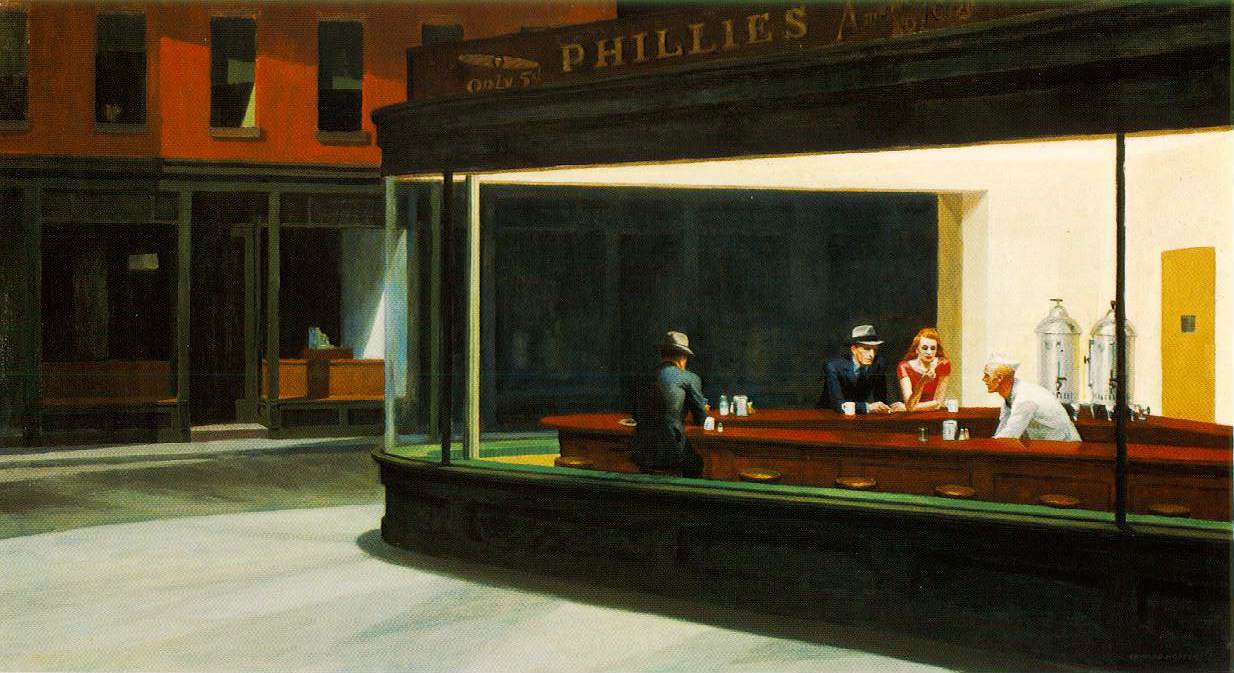
B.B. was passing through town yesterday, so I took a day off and took him to see the Edward Hopper show at the National Gallery. It was excellent. Arranged in more or less chronological order, it started with a dozen or so etchings he made as a young man in the first decade of the XX century. Aside from the one of a man walking along a street under a streetlight, which I vaguely recall having seen somewhere a long time ago, probably at the Whitney, I had never seen any of the etchings before, and they were all beautiful. I think they are shown fairly rarely in general, at least compared to his paintings, but the current show was an excellent opportunity to see them. There were tons of watercolors, also lovely, and, of course, most of the famous oils, including the endlessly parodied Nighthawks, Automat, Room in New York, etc. Very comprehensive.
Hopper has always been one of my favorite artists, even back when I thought Dali was god. Something about the minimalist, yet decisively concrete way in which he depicts things, especially buildings, had always appealed to me on a purely emotional level. The occasional need to be grounded in reality in art as in life, I suppose. And, of course, most of his works, even ones with no people in them, positively ooze loneliness, and any artist who can do that, especially as effectively as Hopper, is alright in my book. But I actually haven't thought about him, and have not come across images of his work, either accidentally or deliberately, in a long time. This made the exhibit that much more enjoyable – I was reminded just how much I love his stuff. There was a quote from a critic – Clement Greenberg, I think – in an on-wall introductory paragraph in one of the rooms. It was something to the effect that Hopper wouldn't have been as good of an artist had he been a better painter (meaning technically). Bunk, I say. The thing that hit me the most yesterday – something I was vaguely aware of before but never really stopped to think about – was the quality of his light. He could pinpoint precisely the time of day or evening (especially evening) by the color of the sunlight on the side of a building, or the angle at which the shadows fell. That's not technique?! His watercolors, too, are astonishingly precise in line, color and composition – all aspects that the watercolor medium supposedly renders so difficult to control.
If I have a complaint about the show at all, it is trivial in the extreme – I was hoping the gift shop would have a reproduction of at least of one of the uncommon etchings. I would have bought one and hung it at home in a second. But, as usual, the lowest common denominator ruled the day, and all they had were the famous oils and a couple of later, colorful large-format watercolors. I contented myself with a poster of House at Dusk and a handful of postcards.
Hopper has always been one of my favorite artists, even back when I thought Dali was god. Something about the minimalist, yet decisively concrete way in which he depicts things, especially buildings, had always appealed to me on a purely emotional level. The occasional need to be grounded in reality in art as in life, I suppose. And, of course, most of his works, even ones with no people in them, positively ooze loneliness, and any artist who can do that, especially as effectively as Hopper, is alright in my book. But I actually haven't thought about him, and have not come across images of his work, either accidentally or deliberately, in a long time. This made the exhibit that much more enjoyable – I was reminded just how much I love his stuff. There was a quote from a critic – Clement Greenberg, I think – in an on-wall introductory paragraph in one of the rooms. It was something to the effect that Hopper wouldn't have been as good of an artist had he been a better painter (meaning technically). Bunk, I say. The thing that hit me the most yesterday – something I was vaguely aware of before but never really stopped to think about – was the quality of his light. He could pinpoint precisely the time of day or evening (especially evening) by the color of the sunlight on the side of a building, or the angle at which the shadows fell. That's not technique?! His watercolors, too, are astonishingly precise in line, color and composition – all aspects that the watercolor medium supposedly renders so difficult to control.
If I have a complaint about the show at all, it is trivial in the extreme – I was hoping the gift shop would have a reproduction of at least of one of the uncommon etchings. I would have bought one and hung it at home in a second. But, as usual, the lowest common denominator ruled the day, and all they had were the famous oils and a couple of later, colorful large-format watercolors. I contented myself with a poster of House at Dusk and a handful of postcards.
Subscribe to:
Posts (Atom)